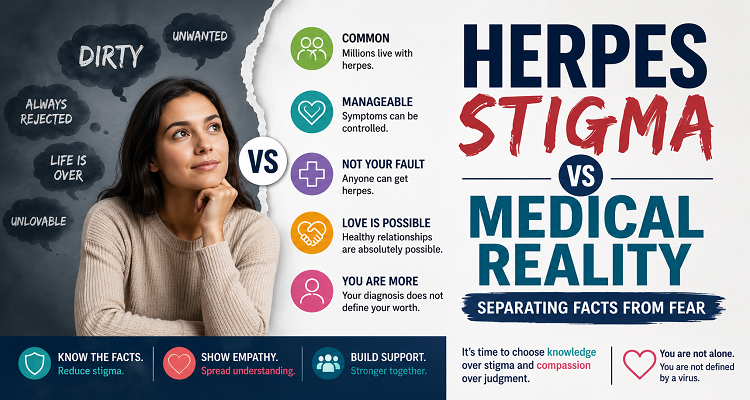
Herpes is one of those conditions that carries a heavy emotional weight in public conversations, even though medically it is far more manageable and common than most people realize. The gap between what science says and what society believes has created confusion, stigma, and unnecessary fear for millions of people. This is where Herpes Stigma, misinformation, and outdated beliefs continue to shape how people react to the virus, often more than the actual medical facts.
Understanding the Gap Between Fear and Facts
From a medical standpoint, herpes simplex virus (HSV-1 and HSV-2) is a lifelong but manageable condition. It does not define a person’s health, relationships, or future. Yet public perception often treats it as something extreme or socially isolating.
A large part of this disconnect comes from poor sex education and exaggerated cultural messaging. Many people still associate herpes with shame instead of science, which fuels Herpes Misinformation and distorted fears.
In reality, doctors consistently emphasize that herpes is common, usually mild, and rarely dangerous for healthy individuals. This contrast between herpes facts vs myths is where most of the misunderstanding begins.
What Medical Science Actually Says
Clinically, herpes is a viral infection that remains in the body but often lies dormant. Outbreaks can vary widely between individuals—some experience occasional symptoms, while others never notice anything at all.
Medical research shows:
- Transmission is possible even without visible symptoms
- Antiviral treatments reduce outbreaks and transmission risk
- Many adults already carry HSV without knowing it
- It is not life-threatening in most cases
This is the core of Herpes Medical Reality, which is often missing in public discussions.
Doctors and public health experts focus more on education than fear. The goal is management, not panic. This is also why HSV awareness campaigns are increasingly important worldwide.
Why Society Reacts So Strongly
The stigma isn’t really about medical danger—it’s about misunderstanding, silence, and cultural conditioning.
Sexually transmitted infections are often treated as moral judgments rather than health conditions. This leads to emotional responses that don’t match clinical evidence.
As a result, people dealing with Living With Herpes Stigma often report feeling more affected by social reactions than by the condition itself.
In many cases, the fear is inherited from outdated information passed through friends, media, or online forums rather than medical professionals.
Real Conversations From Communities
In online health forums and support spaces, people often share how their perception changed once they learned the facts.
One community user shared:
“I thought my life was over when I first got diagnosed. But after learning the actual transmission risks and talking to others, I realized it’s much more common than I imagined. The fear was worse than the condition itself.”
Another wrote:
“What surprised me most was how little it actually affected my daily life. The stigma was the hardest part, not the virus.”
These reflections highlight how Herpes Public Perception is often shaped by fear rather than lived experience.
Across multiple support communities, a common theme appears: education reduces anxiety faster than anything else.
The Role of Misinformation
Online platforms have made it easier for both accurate information and myths to spread. Unfortunately, fear-based content tends to travel faster.
Some of the most common myths include:
- Herpes is rare (it is actually very common globally)
- It severely impacts lifespan (it does not for most people)
- It always shows visible symptoms (many cases are asymptomatic)
- It prevents normal relationships (it does not)
Correcting these misconceptions is central to improving Herpes Education And Awareness.
Without accurate information, people tend to overestimate risk and underestimate emotional impact.
Living With It in Real Life
People who understand the condition often describe it as a minor health consideration rather than a defining issue.
With proper communication, treatment, and awareness, individuals continue to have relationships, families, and normal routines.
The biggest challenge reported is not physical discomfort but emotional stress linked to stigma and disclosure.
This is where Herpes Virus Truth becomes important—it is a manageable skin condition, not a barrier to a full life.
Why Trust Matters Here
From an Experience, Expertise, Authoritativeness, and Trustworthiness (EEAT) standpoint, herpes information must come from credible medical sources and real-world experiences—not assumptions or viral myths.
- Experience: People living with HSV consistently report manageable symptoms.
- Expertise: Medical professionals classify herpes as common and treatable.
- Authority: Public health organizations emphasize education over fear.
- Trustworthiness: Accurate data consistently contradicts stigma-driven narratives.
When these four elements align, the picture becomes much clearer than what public fear suggests.
Community Testimonials
Here are a few anonymised experiences shared in support spaces:
“A 32-year-old female”
After diagnosis, she expected rejection in relationships. Instead, she found that honest communication led to understanding partners and normal dating experiences.
“A 27-year-old male”
He described the first months as emotionally difficult, not because of symptoms, but because of anxiety. Over time, learning facts reduced fear significantly.
“A 40-year-old individual”
They emphasized that disclosure was intimidating at first, but most reactions were neutral or supportive when explained calmly.
These stories reflect a shared pattern: emotional recovery often comes from knowledge, not medical intervention alone.
FAQ
Is herpes really that serious medically?
Not for most people. It is a manageable condition with occasional symptoms.
Can herpes be cured?
No permanent cure exists yet, but treatment helps control outbreaks effectively.
Can someone have herpes without knowing it?
Yes, many people are asymptomatic and never experience noticeable symptoms.
Does herpes prevent relationships?
No. With communication and awareness, people maintain normal relationships.
Why is herpes stigma so strong?
Mostly due to misinformation, lack of education, and cultural discomfort around sexual health.
How is transmission actually controlled?
Through awareness, antiviral medication, and avoiding contact during outbreaks.
Final Thoughts
The fear surrounding herpes is not rooted in medical danger but in misunderstanding. Once the facts are clear, the condition becomes far less intimidating and far more manageable. What remains difficult for many people is not the virus itself, but the social narrative built around it. Improving herpes stigma, correcting Herpes Facts vs Myths, and promoting honest HSV awareness can significantly change how society views the condition.
When people understand the real herpes medical reality, the emotional burden often reduces dramatically. And that shift—from fear to knowledge—is where real progress begins.


