Receiving a positive STI test result can bring many emotions at once. You may feel worried, confused, embarrassed, or unsure about what to do next. The important thing to remember is that an STI diagnosis is a health issue that can be managed with the right information and medical care. A positive result does not define your character or your future relationships.
Taking a few practical steps after receiving your result can help protect your health and reduce the possibility of passing an infection to someone else. Whether you were diagnosed with an STI after a Positive Test, herpes, HIV, HPV, chlamydia, gonorrhea, syphilis, or another infection, your next steps should focus on medical guidance, treatment, communication, and ongoing care.
1. Take a Moment and Understand Your Result
A positive STI test does not always tell the entire story by itself. Different infections require different tests, treatments, and follow-up procedures. Some infections can be cured, while others can be managed with long-term medical care.
Ask Your Healthcare Provider Questions
Contact the healthcare professional or clinic that provided your result. Ask which infection was detected, what the test means, whether additional testing is needed, and what treatment is recommended.
You can also ask how long you should avoid sexual contact and whether your recent partners need testing. Understanding the diagnosis can make the situation feel more manageable and help you make informed decisions.
2. Start Recommended Treatment
One of the most important STI treatment steps is following your healthcare provider’s instructions carefully. Some bacterial STIs can usually be treated with antibiotics. Other infections, including some viral STIs, may require antiviral medicines or ongoing monitoring.
Complete the Treatment as Directed
If medication is prescribed, take it exactly as recommended. Do not stop treatment simply because symptoms improve unless your healthcare provider tells you to do so.
Avoid sharing prescription medication with another person. Your partner may need a different treatment depending on their test results and medical history.
If you experience side effects or have questions about your medication, contact your healthcare provider rather than changing the treatment yourself.
3. Avoid Sexual Contact Until You Know What Is Safe
After receiving an STI diagnosis, temporarily changing your sexual activity may be necessary. The exact recommendation depends on the infection and treatment.
Your healthcare provider can tell you when it is safe to resume sexual activity. For some infections, you may need to wait until treatment is completed and symptoms have resolved. In other situations, your partner may also need treatment before sexual activity resumes.
Following these instructions helps reduce the chance of reinfection or transmission.
4. Tell Recent Sexual Partners
Partner communication can be one of the most difficult parts of receiving an STI diagnosis. However, informing recent partners gives them an opportunity to get tested and receive treatment if necessary.
Keep the Conversation Simple and Respectful
You do not need to explain every detail of your personal history. You can simply tell the person that you received a positive STI result and that a healthcare professional recommended that they get tested.
If you are uncomfortable having the conversation in person, ask your clinic about partner notification services. Depending on the infection and healthcare system, anonymous notification options may be available.
Remember that partner notification is about health information, not blame.
5. Consider Additional STI Testing
Testing positive for one STI does not necessarily mean you have another infection. However, healthcare professionals may recommend additional testing based on your circumstances, symptoms, and sexual history.
Ask About a Full STI Screening
Your provider may recommend tests for infections such as HIV, syphilis, hepatitis B, hepatitis C, chlamydia, gonorrhea, or other conditions when appropriate.
A Full STI Screening can help provide a clearer picture of your sexual health. Your provider can explain which tests are appropriate and whether you need to repeat any tests later.
6. Learn About Your Specific Infection
Education can help replace uncertainty with practical knowledge. Look for information from reliable healthcare organizations, medical professionals, and public health agencies.
Avoid assuming that everything you read online applies to your situation. Symptoms, treatment recommendations, transmission risks, and follow-up requirements can differ significantly between infections.
Understanding your diagnosis can also help you communicate more confidently with future partners.
7. Protect Your Health Going Forward
An STI diagnosis can be an opportunity to review your overall sexual health habits. Depending on your circumstances, your healthcare provider may discuss condoms or other barrier methods, vaccination, regular testing, PrEP for HIV prevention, or other prevention strategies.
Using STI prevention methods consistently can reduce the risk of future infections, although no prevention method provides complete protection against every STI.
Vaccines are available for some infections, including HPV and hepatitis B. Ask your healthcare provider whether vaccination is appropriate for you.
8. Be Careful About Reinfection
Completing treatment does not necessarily prevent you from getting the same infection again. If a sexual partner has not been treated when necessary, reinfection may occur.
This is why STI reinfection prevention matters. Follow your provider’s instructions regarding partner treatment, follow-up testing, and when sexual activity can safely resume.
If symptoms return after treatment, contact your healthcare provider instead of assuming that the infection has completely cleared.
9. Take Care of Your Emotional Well-Being
An STI diagnosis can affect your confidence and relationships as much as your physical health. Feeling upset after receiving the result is understandable.
Try not to blame yourself or make decisions based on shame. STIs are common, and having one does not make someone irresponsible or unworthy of a healthy relationship.
If you are struggling emotionally, consider talking with a trusted person, counselor, healthcare professional, or reputable sexual-health support organization.
Remember That You Can Still Have Healthy Relationships
An STI diagnosis does not mean that dating or intimacy has to end. Honest communication, appropriate treatment, and informed decisions can help you approach future relationships responsibly.
When appropriate, learning how to disclose an STI before sexual activity can help partners make informed decisions together.
10. Keep Your Follow-Up Appointments
Some infections require follow-up testing or additional medical care. Your healthcare provider may recommend returning after treatment to confirm that the infection has cleared, check for reinfection, or monitor your health.
Keep records of your diagnosis, treatment, and follow-up recommendations. This information can be useful when seeing another healthcare professional in the future.
What You Should Do Immediately After an STI Diagnosis
If you are unsure where to begin, focus on these practical priorities:
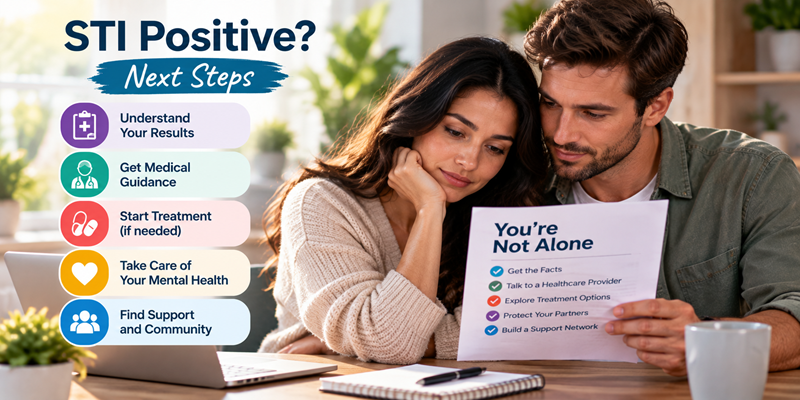
First, confirm what infection was detected and speak with a healthcare professional. Second, follow the recommended treatment exactly. Third, ask when it is safe to have sexual contact again. Fourth, discuss partner notification and additional testing. Finally, learn about prevention and follow-up care.
These STI diagnosis next steps can help you move from uncertainty toward a clear plan.
Frequently Asked Questions
What should I do first after testing positive for an STI?
Contact your healthcare provider to understand the diagnosis and recommended treatment. Ask about additional testing, sexual activity restrictions, partner notification, and follow-up care.
Can an STI be cured?
Some STIs, particularly certain bacterial infections, can usually be cured with appropriate treatment. Other infections cannot currently be cured but can often be managed with medical care. Your healthcare provider can explain what applies to your diagnosis.
Should I tell my sexual partner?
In many situations, recent sexual partners should be informed so they can get tested and receive treatment if necessary. Your healthcare provider or local health department may be able to help with partner notification.
Should I get tested for other STIs?
Possibly. Depending on your diagnosis, symptoms, sexual history, and risk factors, a healthcare professional may recommend additional tests.
Can I have sex after STI treatment?
The answer depends on the specific infection and treatment. Follow your healthcare provider’s instructions about when sexual activity can safely resume and whether partners also need treatment.
Can I get the same STI again?
Yes, some STIs can be acquired again after treatment. Partner testing and treatment, when recommended, can help reduce the risk of reinfection.
Does an STI diagnosis mean I cannot date?
No. An STI diagnosis does not prevent you from having relationships. Learning about your infection, following treatment recommendations, and communicating responsibly can support healthier dating experiences.
Conclusion
A positive STI test can be difficult to process, but it does not have to define your future. The most important steps are to understand your diagnosis, follow medical advice, complete recommended treatment, communicate with partners when appropriate, and attend follow-up appointments.
By learning about Sexual Health After an STI, you can make informed choices about treatment, prevention, and future relationships. Taking action early can protect your health while also helping reduce transmission and reinfection.